Life Value Planner

Real Impact of Loss

A family together beside a lake at sunset. What does losing someone you love really cost?

The first loss is losing someone you love. Nothing can remove that loss.

The second impact can be months of administration, financial pressure, work disruption, health effects, family-time loss and relationship strain. Planning cannot eliminate grief. It can reduce unnecessary work, confusion, financial pressure and disruption.

Some costs can be measured. Some cannot. All of them deserve to be planned for.

Most of us understand that death creates emotional loss. We may also plan for funeral expenses, legal costs and immediate bills.

What we rarely calculate is everything that happens next.

How many hours will someone spend calling banks, insurers, government agencies, lawyers and service providers? How much work will they miss? How many evenings and weekends disappear? Will someone need counselling? Who watches the children while an executor meets with a lawyer? Who prepares meals, cleans the house, mows the lawn or shovels the driveway while the family handles everything else?

Let's make some of the invisible impact visible.

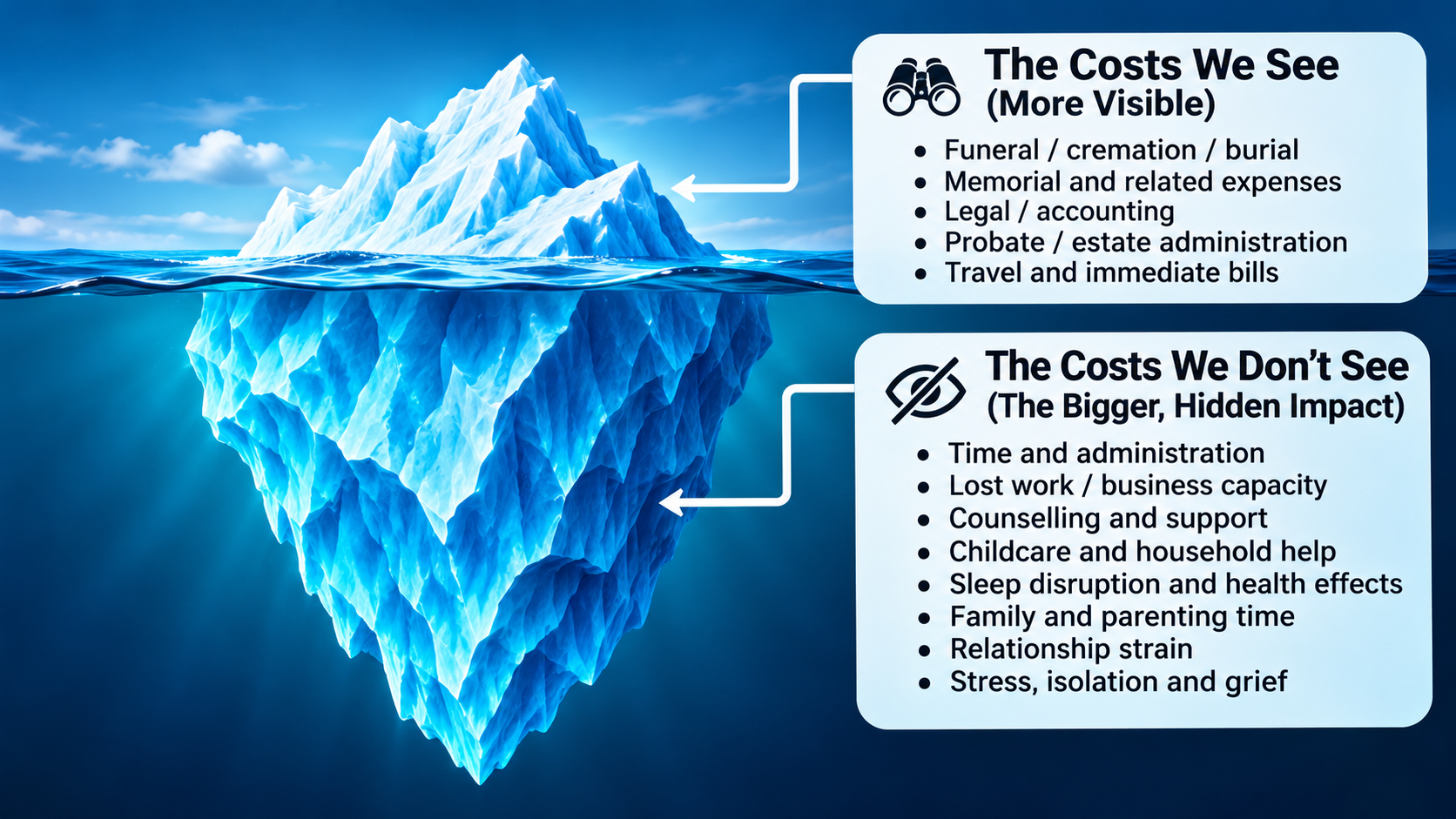
The Costs We See—and the Costs We Don't

Visible expenses above water; hidden time, work, support and human burdens below the surface.

Above the surface

Funeral / cremation / burial · Memorial · Legal/accounting · Probate / estate administration · Travel · Immediate bills

Below the surface

Administrative time · Lost work/business capacity · Phone calls and hold times · Evenings and weekends · Counselling · Childcare · Meal preparation · House cleaning · Lawn/snow/home maintenance · Sleep disruption · Health effects · Family time · Parenting capacity · Relationship strain · Stress/isolation · Time actually available to grieve

The cheque isn't always the biggest cost.

Evidence behind the invisible burden

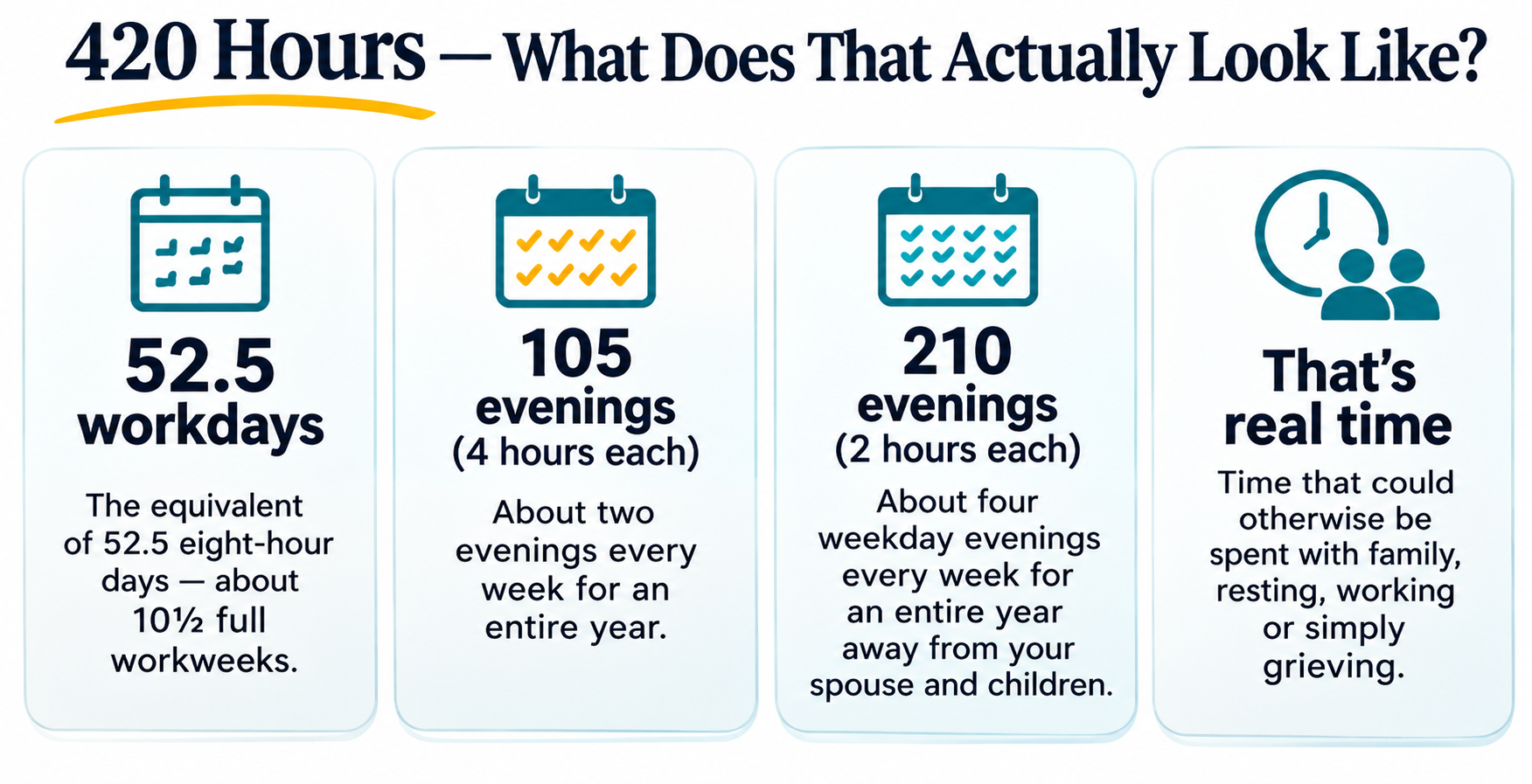
According to the research, it can take about 420 hours to resolve the problems left behind when you lose a loved one.

Where will those hours come from?

420 hours: 52.5 eight-hour workdays, 10.5 workweeks, 105 four-hour evenings or 210 two-hour evenings.
420 hours = 52.5 eight-hour workdays = 10.5 full workweeks = 105 four-hour evenings (about two per week for a year) = 210 two-hour weekday evenings (about four per week for a year). An approximate research reference, not a prediction.

420 hours

Families reported about 420 hours completing post-loss tasks.

U.S. · Families managing post-loss tasks

Empathy — The Cost of Dying, 2022

A research reference, not a prediction for your family. Executors reported about 570 hours; choosing an executor role does not change your estimate.

Those hours must come from somewhere: work, evenings, weekends, parenting, sleep, exercise, relationships, recovery or personal time.

Some costs can be measured. Some cannot. All of them deserve to be planned for.

Later research: weekly commitments and duration

20 hours a week

Families reported about 20 hours per week on post-loss responsibilities; financial matters took an average of 12.5 months to resolve.

U.S. · Families managing post-loss responsibilities

Empathy — The Cost of Dying, 2023

Different study framing from the 2022 total; do not multiply these figures into a universal expected burden.

19.5 months

Average executor responsibility lasted 19.5 months.

U.S. · Executors surveyed among 1,500 bereaved adults involved in estate settlement

Empathy — The Grief Tax, 2025

Canadian context

U.S. costs are not Canadian averages. Direct costs, probate, estate administration and legal expenses vary materially by jurisdiction.

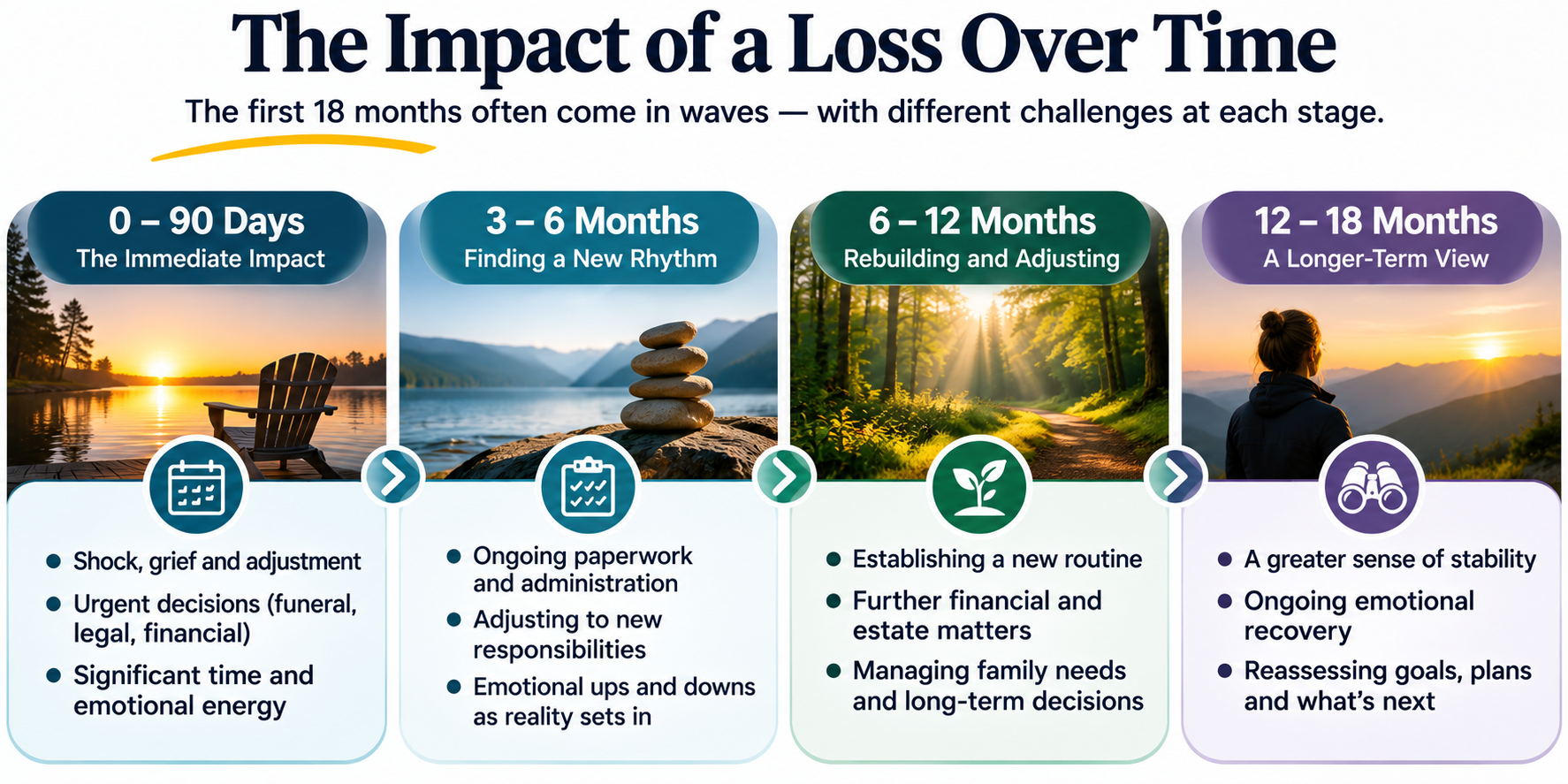
The Impact of Loss Over Time

An illustrative loss timeline: immediate impact, finding a rhythm, rebuilding and taking a longer-term view. Experiences do not follow a fixed schedule.
This supplied timeline is an illustration, not a prediction or a required allocation. Experiences do not follow a fixed schedule.

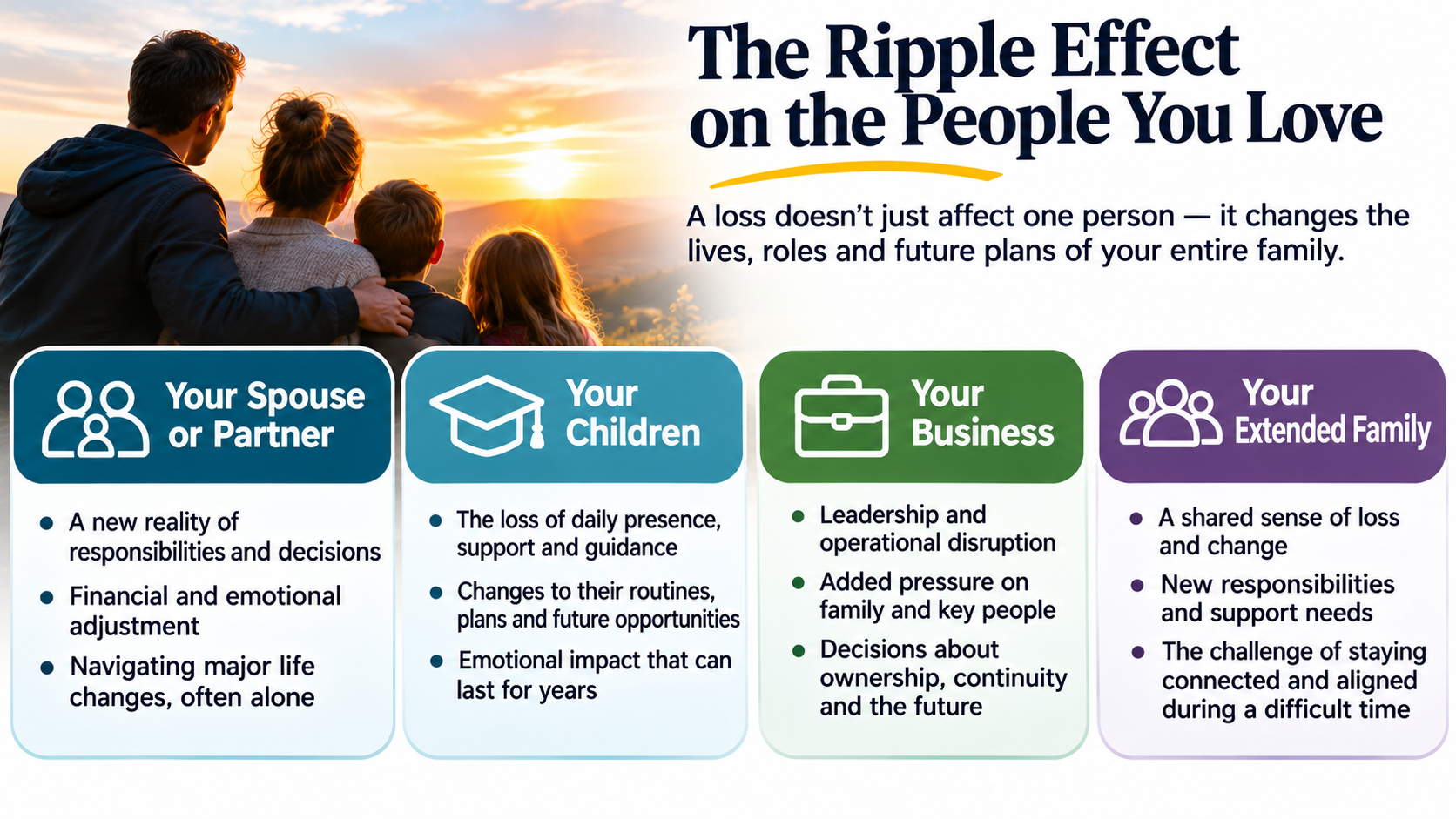
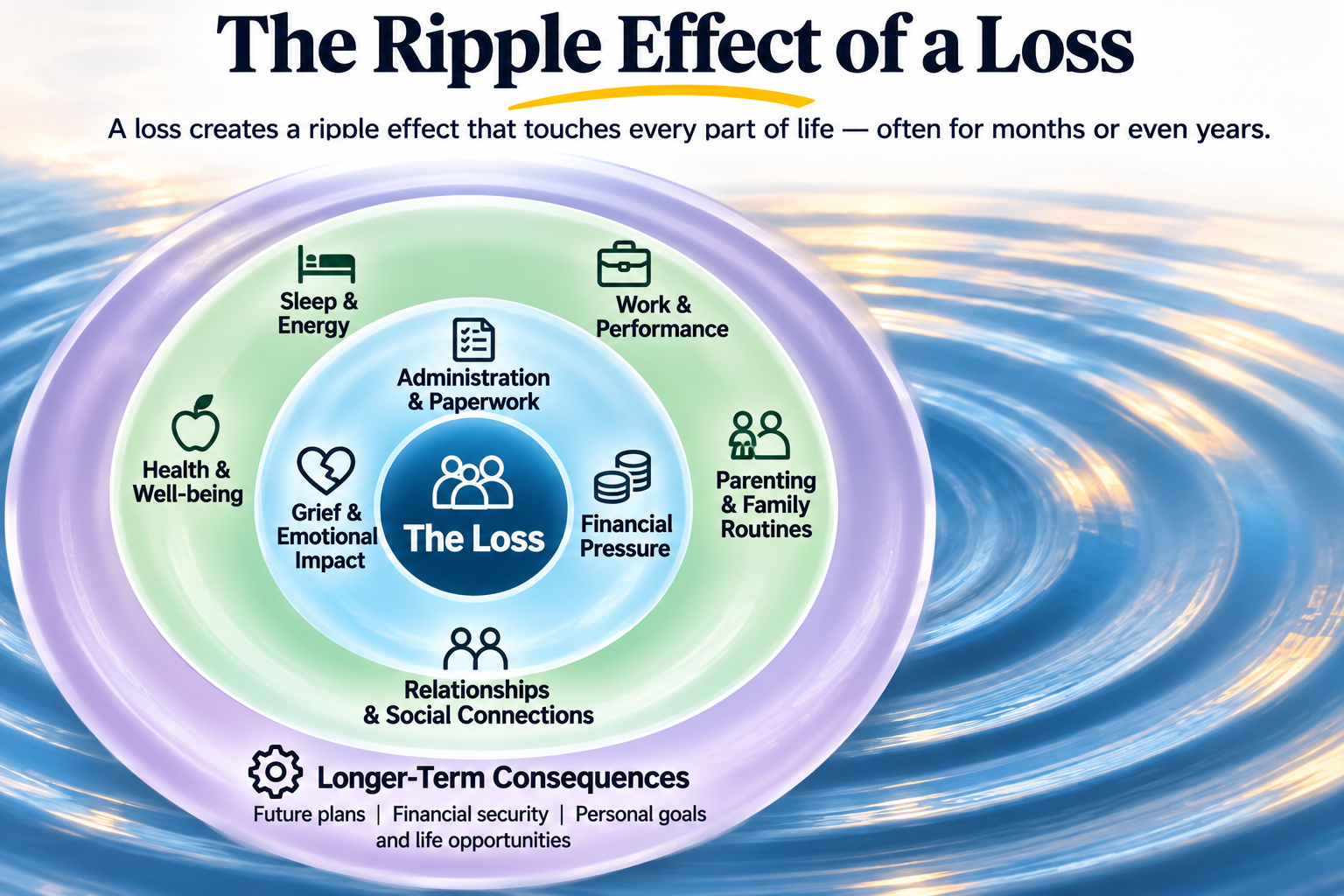
The Ripple Effect on Family Life

Possible ripple effects for a spouse or partner, children, business and extended family.
The funeral is only one immediate expense. Life Value Planner’s suggested 90-Day Family Transition Fund addresses the immediate financial transition—not the entire administrative, workplace, health or family impact, which may continue much longer.
Loss can create administrative, emotional and financial demands that intersect with sleep, work, health, parenting and relationships.
These are possible intersections, not inevitable outcomes. No money is automatically assigned to lost clients, contracts, promotions or career opportunities.

Children’s Emotional Support

Younger and older children may experience loss differently. Support, conversation and parental presence can matter at every age.
Children can experience loss differently at different ages. A grieving child may need more parental presence at exactly the time a surviving parent or caregiver has less time and emotional capacity. No mental-health outcome is predicted.

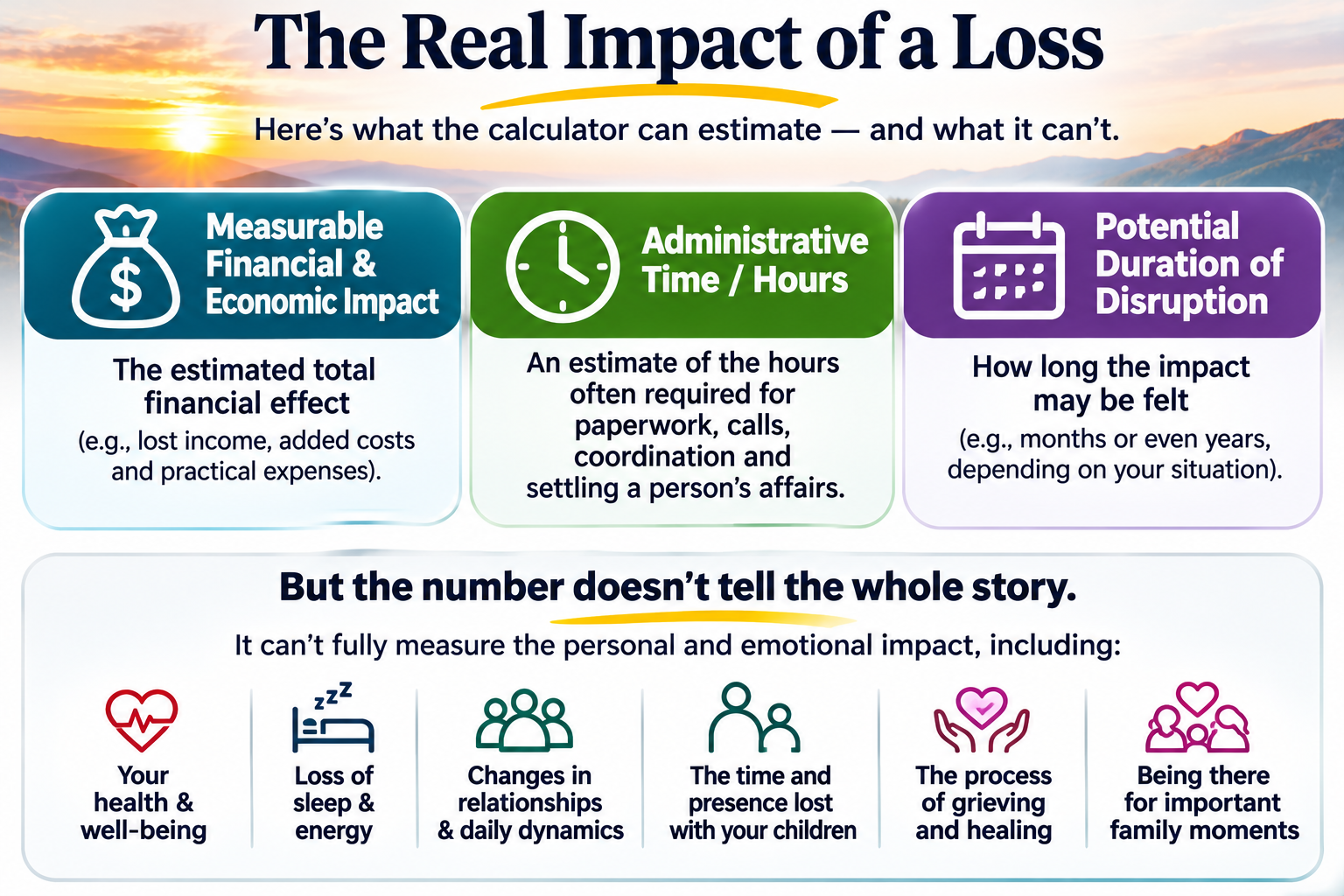
What the Estimate Can—and Cannot—Measure

Three measurable dimensions: financial and economic impact, administrative hours and potential duration. Health, sleep, relationships, parenting, grieving and family moments are not fully captured.
This framework describes what can be estimated. Your calculator results are separate; experiences vary and the selected duration is not a prediction.

Real Impact of Loss

Now Make It Personal

Research tells us what other families experienced. These questions help you explore what a similar loss could mean in your life.

This is an educational planning estimate, not a prediction.

No email required. Answers remain in this browser tab during your session. Do not enter names, credentials or private medical information.

Planning location / currency

Amounts are in CAD. Switching countries relabels your entered amounts; it does not convert them. Research retains its original geography and currency.

Canadian research: the burden is not only a U.S. experience

1 / 8 · Time

Research reference — Empathy 2022 (U.S.)

hours

50–800 on slider · You can type another amount.

420 hours

Families reported about 420 hours completing post-loss tasks.

U.S. · Families managing post-loss tasks

Empathy — The Cost of Dying, 2022

A research reference, not a prediction for your family. Executors reported about 570 hours; choosing an executor role does not change your estimate.

Economic value of time—not necessarily money your family literally pays, and not a price on family life.

Planning default — adjust to your circumstances

CAD/hour

25–500 on slider · You can type another amount.

420 hours × $50 = $21,000 economic value of time

52.5 eight-hour workdays · 10.5 full workweeks · 105 four-hour evenings · 210 two-hour blocks

Planning for the people you love

What could I do today to make this easier for the people I love?

Your legacy plan isn't only about where your money goes. It's also about how much work, stress, cost and disruption you leave behind for the people you love.

  • Would your family know where everything is?
  • Could they access important documents?
  • Does your executor understand your wishes?
  • Are beneficiaries current?
  • Is immediate liquidity available?
  • Does your family know whom to call?
  • Are funeral/memorial wishes known?
  • Is there a business continuity or wind-down plan where relevant?
  • Are children's needs and guardianship wishes appropriately documented?
  • Would your family have room to grieve—or immediately become administrators?

You Can't Prevent Grief. You Can Reduce Unnecessary Burden.

1

Organize

Financial, legal, insurance and estate documents.

2

Communicate

Tell appropriate people where information is and what you want.

3

Choose

Executors, guardians and attorneys/agents thoughtfully.

4

Fund

Consider immediate liquidity and transition needs.

5

Document

Wishes, accounts, contacts, property and digital information.

6

Prepare

Have conversations before a crisis.

7

Review

Beneficiaries, documents, insurance, ownership, contacts and plans periodically.

Preparation does not guarantee an easy process or remove grief. No percentage reduction in burden is assumed.

Before You Name an Executor, Have a Conversation

Questions and practical actions to review
  • Do they know they have been selected?
  • Do they understand likely responsibilities?
  • Do they know where documents are?
  • Can they access needed information?
  • Who are the lawyer, accountant and financial professionals?
  • Is property or a business involved?
  • Are family dynamics likely to complicate decisions?
  • Are they also a caregiver or parent?
  • What work responsibilities are they balancing?
  • Who can help them?

19.5 months

Average executor responsibility lasted 19.5 months.

U.S. · Executors surveyed among 1,500 bereaved adults involved in estate settlement

Empathy — The Grief Tax, 2025

A Plan Nobody Can Find Isn't Much of a Plan

Questions and practical actions to review
  • Will / trust
  • Insurance policies and beneficiary information
  • Bank / investment information
  • Tax records
  • Property information and debts
  • Business documents
  • Professional contacts
  • Funeral / memorial wishes
  • Digital accounts / access instructions
  • Subscriptions
  • Government information
  • Key family contacts

Keep access instructions secure and share appropriately. Never enter passwords, SIN/SSN, account numbers, credentials or private medical information into this calculator.

67%

67% encountered missing information; 39% could not locate documents and 28% could not access passwords or accounts.

U.S. · Respondents managing post-loss responsibilities

Empathy — The Cost of Dying Report, 2024

Check What Support Already Exists

Questions and practical actions to review
  • Bereavement leave
  • Paid time off
  • Flexible work
  • EAP / EFAP
  • Mental-health benefits
  • Counselling coverage
  • Family-assistance programs
  • Disability coverage where applicable
  • Employer grief resources

Ask about eligibility, limits and how to access support. Employers and benefits differ by workplace and jurisdiction.

Why the 90-Day Family Transition Fund exists

The funeral may be one of the easiest costs to see. The larger impact can unfold over hundreds of hours and many months—in work, family responsibilities, health, relationships and the time actually available to grieve.

Life Value Planner’s Final Expense estimate and suggested 90-Day Family Transition Fund help address the immediate financial transition. Thoughtful legacy planning may need to go further. Planning can’t eliminate grief. It can eliminate some unnecessary work, uncertainty and financial pressure surrounding it. Insurance can be one component—not the entire solution. Organized records, legacy letters, a Family Constitution, beneficiary planning and qualified professional advice may also help.

What Several Years of Research Have Revealed

  1. 2022

    Scale becomes visible

    ~420 hours; ~13 months; direct financial and productivity costs. Source: Empathy, The Cost of Dying, 2022 (U.S.).

    Read research
  2. 2023

    Daily burden becomes clearer

    ~20 hours/week; 12.5 months resolving financial matters. Source: Empathy, The Cost of Dying, 2023 (U.S.).

    Read research
  3. 2024

    Duration and executor burden

    ~15 months overall; ~18 months for executors; account/document complexity. Source: Empathy, The Cost of Dying Report, 2024 (U.S.).

    Read research
  4. 2025

    Compounding Grief Tax

    19.5 months average executor responsibility; caregiving, work and family pressures. Source: Empathy, The Grief Tax, 2025 (U.S.).

    Read research

The measurable cash cost has not risen dramatically in the supplied research. What the research increasingly reveals is the hidden human cost: time, work disruption, health, administration and family impact. The reports do not use identical questions, samples or endpoints. This timeline shows how research has expanded understanding; it should not be read as proof that every measure worsened each year.

Where Our Information Comes From

This experience combines user-selected planning assumptions with published research on bereavement, estate administration, workplace impact, family life and professional support. Research findings are identified throughout the page so you can distinguish published evidence from calculator assumptions.

Some costs can be measured. Some cannot. All of them deserve to be planned for.

Educational Planning Estimate

This tool is provided for educational and planning purposes only. Results are based on the information and assumptions you select together with published research and planning estimates. Actual costs, time requirements and experiences vary significantly by family, estate, jurisdiction and circumstances. This tool does not provide legal, tax, medical, psychological or financial advice. Consult appropriate qualified professionals regarding your circumstances.